Tommaso Pestelli: balance between nature & artifice

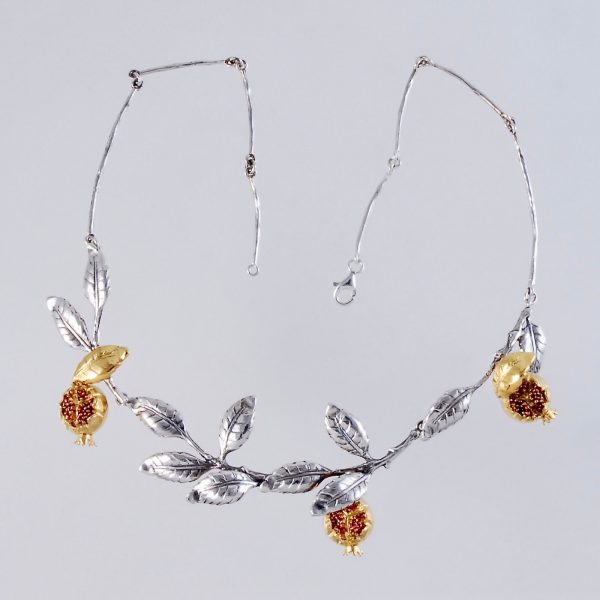
A fourth-generation member of an important Florentine goldsmith dynasty, appointed MAM – Maestro d’Arte e Mestiere by the Fondazione Cologni dei Mestieri d’Arte in 2020, Tommaso Pestelli has forged a personal path that has enabled him to broaden the horizons of his family’s historic workshop. He began with himself and with his innate vocation to seek, in objects, the balance between nature and human craftsmanship: that magic he admired, as a young student, in the great Medici collections.
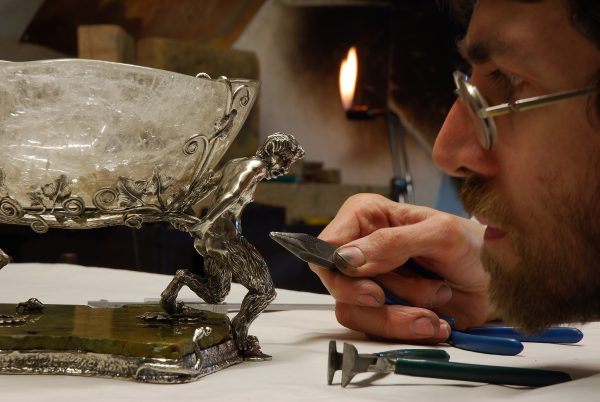
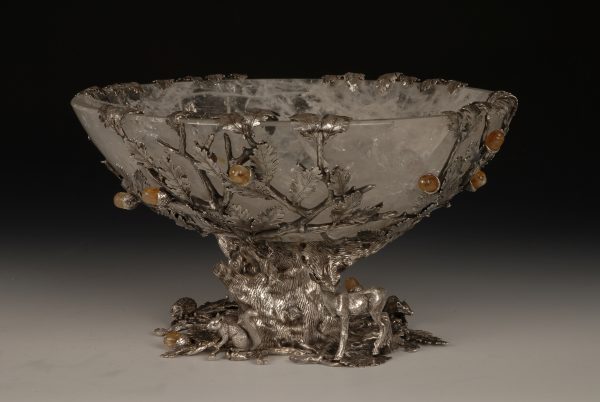
In his workshop every creation – from the simplest jewel to the grand objet d’art inspired by the Renaissance and Mannerist tradition – passes through his hands. It is a choice, even before it is a form of control: each piece must embody his gaze, his idea, his responsibility. And yet, he tells us, the workshop could not have become what it is without his father, who supported his inclinations; without his wife, who works by his side; and even without his son, who directs him toward the future.
Your training took you through the workshop, the Academy and the Opificio: how did you find your own personal path?
I owe a great deal to my father and to his intuition. He quickly understood my need for self-expression, my desire to create something of my own, and he knew I would feel constrained within the sole dimension of jewelry, if understood in the traditional sense.
He first supported my wish to study sculpture at the Academy of Fine Arts. The true revelation, however, came from the opportunity to admire the great Medici collections, where jewelry is also sculpture, furnishing object, technical marvel and pure fantasy. From there came the idea of allowing me to pursue restoration studies at the Opificio delle Pietre Dure: it was an extraordinary school, which taught me respect for materials, for their history and their fragility. Step by step, I found my own path, also following a particular predilection for hidden details, for those creative solutions between technique and aesthetics, for those “caprices” that are typical of the great Florentine tradition.

In your work the word “balance” recurs frequently. What does it mean to you?
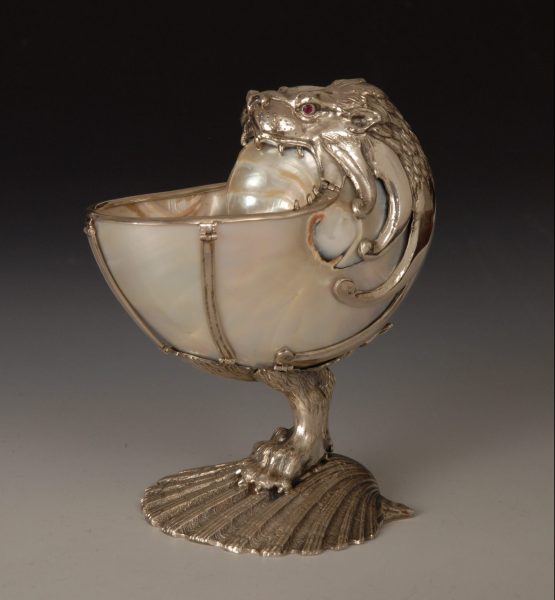
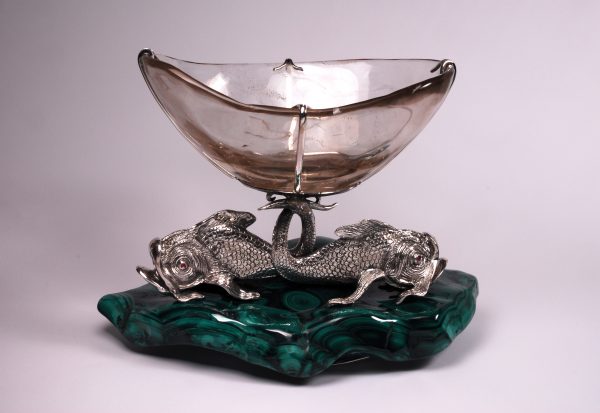
I have a natural inclination toward balance, nurtured by the study of the classics. In particular, I love all those objects from the past that, at first glance, convey a sense of perfect equilibrium between nature and artifice. I am thinking of works in which shells, corals and hardstones converse with gold, with metals, with human invention. Sometimes, what creates harmony is precisely an element that appears dissonant.
In your practice you engage daily not only with the Florentine tradition but also with your family’s heritage. What role does the Pestelli archive play in your creative process?
It is a private archive that represents an inexhaustible source of inspiration. We preserve thousands of silver models, drawings, fragments, parts of ornamental objects. I often find myself admiring them and thinking they are made better than I would be able to make them. I am deeply fascinated by the freedom with which, at the end of the nineteenth century, different styles were blended: classical, Renaissance, naturalistic. I love that capacity for hybridization. The archive is not a repertoire to be copied, but fertile ground where ideas intertwine and transform.

Your clientele is highly diverse: great Florentine and international families, tourists, luxury brands with whom you collaborate. How is this reflected in the workshop’s production?
Naturally, production varies according to the commission, but there is one constant: every single object that leaves the workshop passes through my hands. It is a form of control, certainly, but above all it is an assumption of responsibility. It must represent me, my name, my gaze.
My objets d’art, those closest to the late Renaissance and Mannerist tradition, always originate from my own idea. Often everything begins with a falling in love: with a particular stone, a shell, a coral, an ostrich egg. Imagination, combined with experience, gradually guides me toward the final form. It is precious when I meet a patron with whom there is a shared sensibility: a shared pleasure arises, forming the basis of genuine human relationships, even before commercial ones.
Your wife also works alongside you. What kind of dialogue develops between you?
I met Eva during my studies, and everything would have been different without her at my side. She is an established artist working in graphic design, and she brings into the workshop her entire world – shaped by a different gaze and an extraordinary creativity. She not only carefully manages client relations, but also contributes during the design phase and, given her skills in engraving, in decoration and finishing as well.

Your son represents a possible future for the workshop. What is his role?
My son Paul is twenty and studies product design. He strongly stimulates me in the field of innovation: tools, technologies, new processes. I believe these processes must be integrated into artisanal practice, yet always remain complementary to manual work, because only the human gesture gives an object a life that goes beyond technical perfection. He also pushes me toward products with a cleaner, more contemporary taste and toward collaborations with designers, which greatly interest us. We are currently working, for example, on the “Doppia Firma” project of the Fondazione Cologni dei Mestieri d’Arte, to be presented at the next Milan Design Week, which will see us engaged in the creation of an object designed by an important name in the design world.
Looking back at your journey, what do you feel you have received, and what would you like to pass on?
I consider myself very fortunate. My family believed in my dream; they gave me trust and space. They allowed me to carve out a non-linear path, to study sculpture and restoration, to enrich my skills organically and to see my personal inclinations supported. It is something I wish for all young people: to have the time and the freedom to truly understand who they are.
PESTELLI CREAZIONI
Via del Sole, 22R
Firenze (FI) – ITALY
+39 055 2302488
info@pestelli.com
www.pestelli.com
Mustras: Objects That Rediscover Meaning

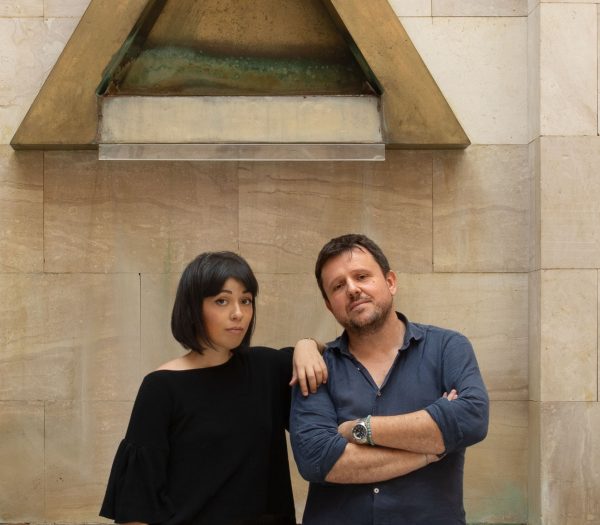
Architect and designer Fabrizio Felici and contemporary art manager Martina Carcangiu are the founders and artistic directors of Mustras, a project born in Sardinia in 2019 and developed through the contribution of a collective of artists, architects, designers, and artisans engaged in an investigation of the idea of dwelling. By weaving together theory and practice, tradition and design, in just a few years Mustras has given life to more than ninety unique objects. These works emerge from an interdisciplinary dialogue that allows them to move beyond everyday use and enter a more extraordinary sphere—one in which objects can once again be recognized as bearers of meaning, from a contemporary rather than nostalgic perspective. At the heart of the project lies the role of Sardinian artisans, true custodians of the essential bond between material, territory, and tradition.

How do the objects of the Mustras project come into being?
Mustras is an evolving container. Some projects originate from our own direct initiative, while others come from outside, proposed by designers or architects with whom we enter into dialogue. In every case, we follow the entire process—from the initial idea to its realization—identifying the artisan best suited to translate the project into a tangible object. Over the years, Mustras has grown through dialogue, gathering proposals, reflections, and works that become part of a constantly evolving body of research.

What role do artisans play?
Artisans are at the very core of the project, because they embody a deep connection with the territory, with tradition, and with a form of knowledge that adds depth to objects—a sort of “third dimension.” This is a heritage we have seen gradually fade over time, and Mustras was also conceived as an attempt to restore value to this immaterial legacy, which tends to lose its balance when artisanal production focuses primarily on tourist-oriented goods.
We are convinced that the mingling of skills generates mutual growth: designers and artists learn from artisans, and artisans, in turn, engage with new ways of seeing. We ourselves were the first to learn from what we observed and absorbed in the workshops.

Can you give us some examples of this “third dimension”?
Historically, many objects closely tied to domestic life constituted a true language. Objects were not merely functional: they told stories, relationships, and ways of living. The carved wooden madie (storage chests), for example, were rich in symbols and decorative elements that, depending on their arrangement, narrated the history of a family and the relationship between the bride’s and groom’s families.
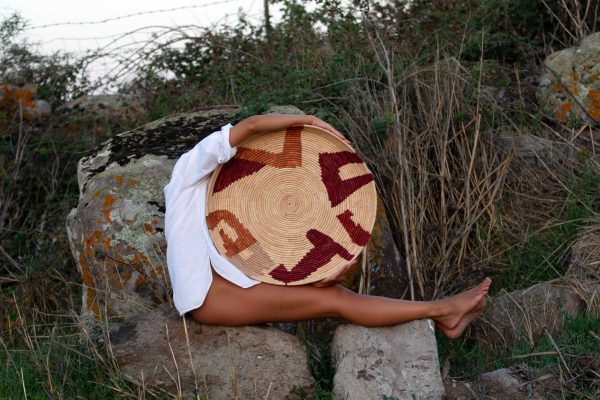
The very name Mustras comes from sa mustra, the preparatory sketch that carpenters used to carve these chests. Each workshop jealously guarded its own mustras, which functioned as a local code, a shared lexicon. The same applies to certain textile traditions, such as the carpets of Nule, rich in religious or natural references that worked as visual narratives.
As these practices have gradually disappeared and our daily lives have changed, this language also risks being lost. Our goal has never been to reproduce it directly—that would be anachronistic—but rather to identify a line of continuity: to remain fully contemporary while seeking a thread that connects us to those elements of tradition. This approach takes different forms each time, depending on the project.

Is Mustras a project exclusively tied to Sardinia?
Our choice to work with Sardinian craftsmanship is linked to our origins, but also to the specificity of that context. Sardinian craftsmanship is a true continent—a nebula of techniques, materials, and possibilities. Insularity has certainly helped preserve strong aspects of identity. This character is our point of departure, set within a contemporary framework marked by strong cultural and architectural homogenization.
That said, Mustras is not a closed regionalist project. Its approach is transferable. Our aim is not to build fences, but bridges: to start from a local heritage and engage in dialogue with a broader, contemporary, and open horizon.

Could you tell us about some creations that have emerged from the project?
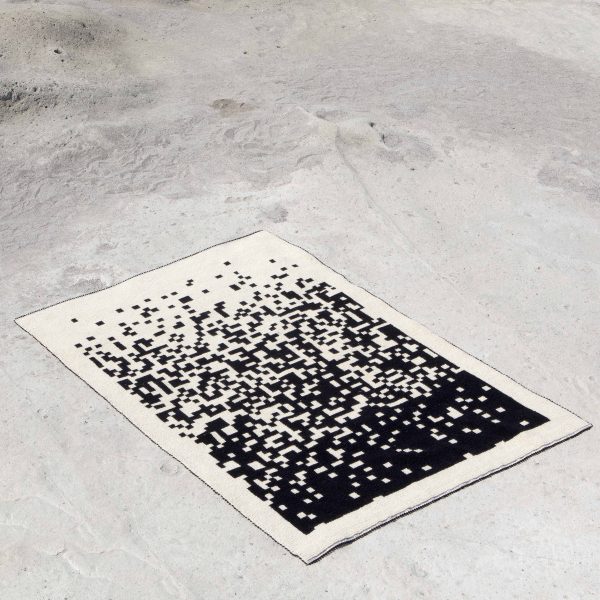
Among the works that best represent Mustras is Q.R. Quanta Res, a pibiones wool textile designed by Fabrizio Felici and Alberto Olmo. The project stems from an investigation into the concept of memory in relation to dwelling, specifically in dialogue with the territory of Seulo and the waterfall of Sa Stiddiosa, a symbolic place for the local community. The “pixelated” degradation of the weave recalls the dripping—su stiddiu in Sardinian—of water, and resonates with the idea of the QR code as a container of memory and data.
Another project, Offshore by Marco Loi, addresses the issue of production decentralization in a more explicitly critical way. Starting from labels of industrial products sold in supermarkets—made abroad yet referencing local craftsmanship—the designer transformed them into textiles produced in Sardinia. A gesture of reappropriation, both artisanal and conceptual.

There is also a more intimate work: an embroidered tablecloth designed by Martina Carcangiu and based on a text by Ernesto Nathan Rogers, published anonymously in Domus in the 1940s. The text, reflecting on the notion of dwelling, was embroidered on linen using a 1950s pedal-powered machine. The colors derive exclusively from natural dyes obtained from raw materials from southern Sardinia, demonstrating that the bond with place can pass through the choice of materials as much as through technique.

What lies ahead for the Mustras project?
Today, Mustras comprises around ninety pieces and has been selected for several prestigious exhibition contexts. The attention received from magazines and institutions came unexpectedly, like an echo that quickly traveled beyond the local sphere. Our hope is that this work can also have a tangible impact on artisanal workshops, because a unique piece—no matter how meaningful—is not enough to economically sustain a practice.
We are currently working on a commercial development that can preserve, on the one hand, the foundational value of craftsmanship and, on the other, the importance of design-driven reflection. We believe that certain objects can move beyond everyday use and enter a more extraordinary realm, where they can once again be recognized as bearers of meaning.