


ANTONIETTA MAZZOTTI EMALDI: “MY CERAMICS PUSH THE MATERIAL TO THE LIMITS OF THE POSSIBLE”
Among the leading voices in contemporary Faentine ceramics, Antonietta Mazzotti Emaldi speaks about the exhibition project she will present in Florence on the occasion of Artigianato e Palazzo (11–13 September 2026), the thirty-second edition of the now historic showcase of high craftsmanship held in the Corsini Garden and its evocative spaces. Realised as part of the contemporary patronage project La Grande Bellezza. The Dream Factory, promoted by Starhotels in collaboration with Fondazione Cologni and Gruppo Editoriale, the exhibition brings together works from her most recent collections in a journey that weaves together classical elegance, formal research, and technical experimentation, pushing the ceramic medium to the limits of its expressive possibilities.
How did you receive the invitation from Fondazione Cologni to take part in the Starhotels La Grande Bellezza project?
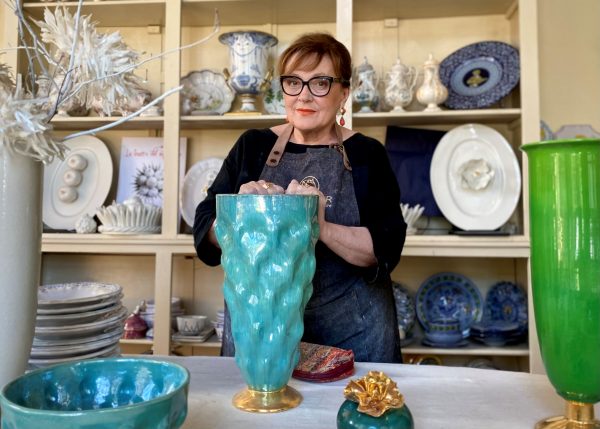
When I was contacted by Fondazione Cologni, I was deeply moved. I participated in the first edition of Artigianato e Palazzo in 1995 and in the ten editions that followed, and I hold a wonderful memory of Donna Giorgiana Corsini, who personally invited me that first time. I watched this event come into being, then life took me elsewhere. Being able to return to Palazzo Corsini in a new guise carries a special meaning. During the years I exhibited there, I presented the classical Faentine majolicas of my Manifattura — traditional forms and decorations, executed faithfully and to the highest standard. Then my academic training — in sculpture and modelling — swept me away. While keeping the production of classical artistic majolicas active, I personally left tradition behind to devote myself to my own artistic expression.
What will you bring to Florence?
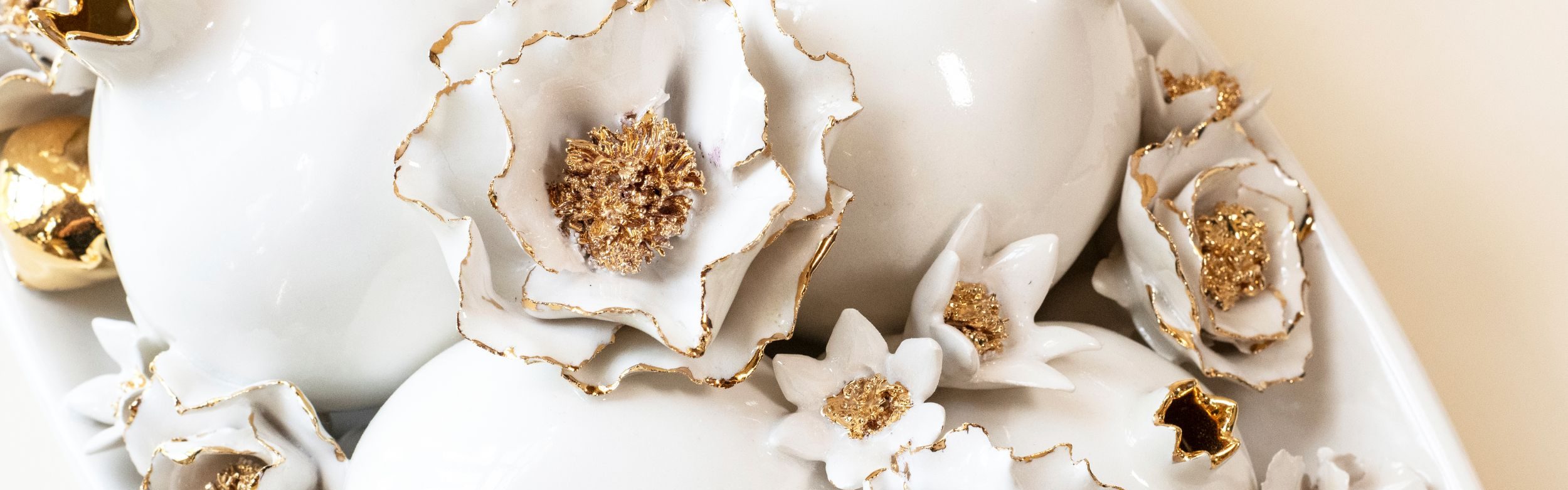
To Palazzo Corsini I will bring four collections, united by a single stylistic leitmotif: white and gold.
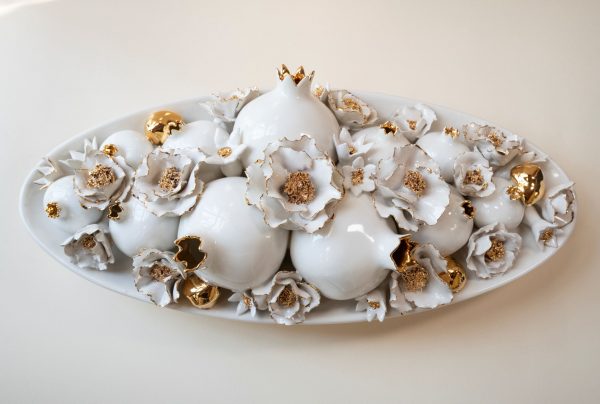
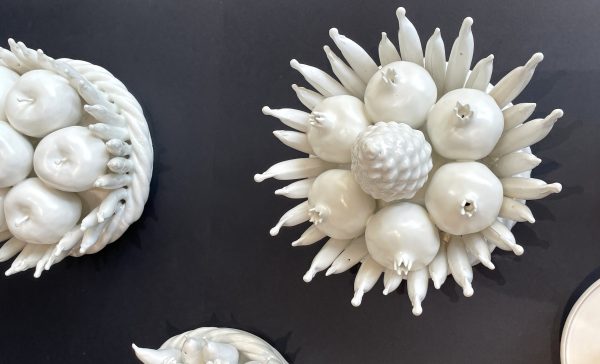
There will be Proserpina, a line dedicated to pomegranates and their blossoms, symbols of abundance, already selected in 2024 for the third edition of Homo Faber, held at the Fondazione Giorgio Cini in Venice.
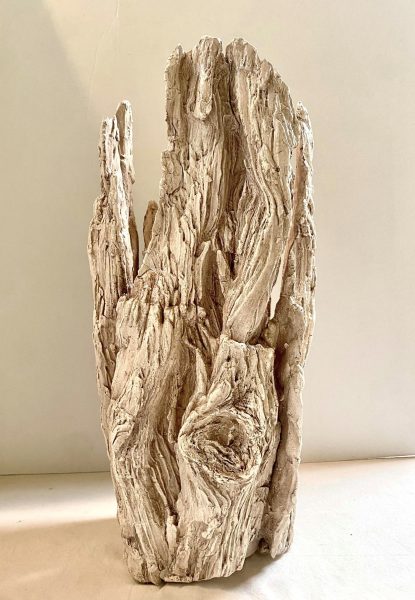
I will present Survival — vase-sculptures made in 2022 to mark the fiftieth anniversary of my activity. I cast the bark of the trees in the park of Villa Emaldi — sequoias and other century-old specimens that have withstood wars, storms, and lightning. It is also a synthesis of my life: fifty years as a ceramicist and mother of three children, in a traditionally male Italian environment where a woman with artistic ambitions does not have an easy time. The resilience of those trees is also mine.
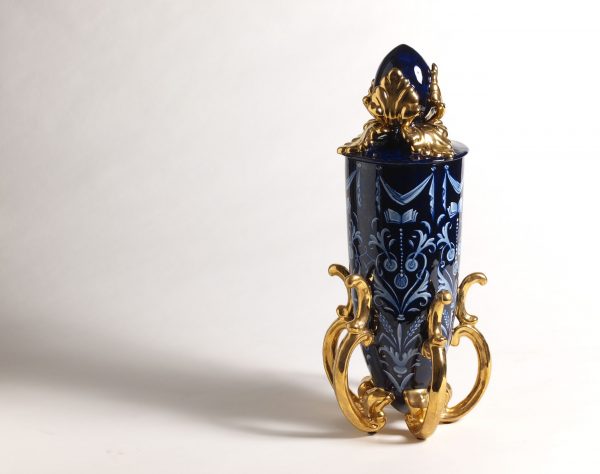
The exhibition will also include Faience Garden, a project born in 2024 from my participation in the Starhotels La Grande Bellezza competition: the aim was to propose a Souvenir d’Italie object representing the territory’s tradition in a contemporary key. I chose to start from the carnation — Faenza’s most celebrated decoration, rendered by now in every conceivable variation. I reinterpreted it in relief, in white and gold.
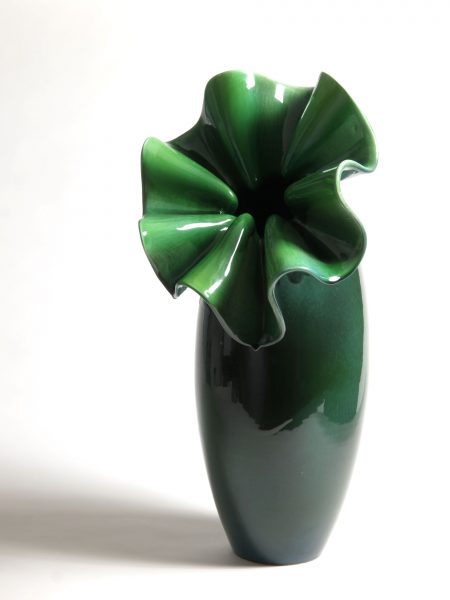
Finally, I will present Menadi, my most recent collection, inspired by the bacchantes, the women who follow Dionysus’s retinue: transgressive figures wrapped in billowing veils, like those of Botticelli’s Venus. I sought to render that lightness in ceramics — a material that is anything but light — through geometric white vases adorned with swirling flourishes in pure gold leaf.
On the subject of transgression: Ugo La Pietra used precisely that word in relation to your work. What does it mean to you?
That word is not accidental, and La Pietra has grasped an important aspect of my work: I push the material to the limits of the possible. Making these swirling flourishes hold around the majolica vases, keeping them in position, demands an exceptionally high level of technical skill. The same is true of the bark pieces: they are beautiful, but the casts are complex and must hold their balance. My ceramics are not easy to execute. In my case, transgression is technical.
What remains of the Faentine tradition in your recent output?
The pursuit of beauty. Faentine majolica has a centuries-long tradition, from the fourteenth century to the present day, and its defining quality is excellence, perfection, elegance. My masters taught me that Faenza ceramics must be beautiful: even the humblest Faentine kept his little plate in the display cabinet of the sitting room. Our ceramics have always been regarded as precious, and it is that preciousness that keeps me bound to tradition.
Could one say that you have “renewed” that tradition?
Yes, because I had a serious education: an arts diploma at the renowned Ballardini — the institute for ceramic art — then the Academy of Fine Arts. I have studied all my life and remain culturally active to this day. After the years of classical production, I returned, rather, to my contemporary training. My husband has a passion for ancient ceramics, so I have always looked to originals: personally formulating my own glazes and pigments, never using commercial products. Then, after a few decades, I took my passion back in hand and began doing what I truly wanted, while preserving the elegance that is typical of Faenza.
The Starhotels prize is called “La Grande Bellezza.” You have spoken of beauty as the hallmark of Faentine production. What is beauty, for you?
It is a difficult concept, often subjective. For me, beauty is something that stirs an emotion, and it is also perfection: many people say that ugliness is beautiful, and I find that somewhat hard to accept. Today, for instance, textural ceramics are very widespread: I understand they may have their appeal, and I would not presume to judge, but my Faentine training has taught me something different. Ceramics must be smooth, perfect, elegant. My concept of beauty remains tied to good taste — an indispensable quality that makes something pleasing to the eye and capable of moving you.
Where does your inspiration come from?
From nature and from myth. The last few years have been the most fertile. During the lockdown, at the time of the Dante commemorations, I created Le frutte del mal orto, a collection inspired by an episode from medieval tradition connected to the figure of Manfredi and the history of Manfredian Faenza. That work marked a turning point towards the contemporary.
Pomegranates for Proserpina, bark for Survival, carnations for Faience Garden, golden flourishes for Menadi: nature and classical mythology are my guiding threads.
You run workshops at Villa Emaldi and often involve young people in your practice. How important is the transmission of craft knowledge?
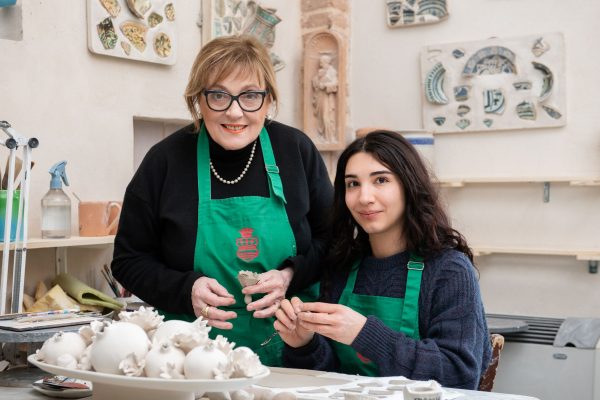
I enjoy teaching: when an intern arrives, they must follow their own path, and one has to guide them. I entered at eleven and left at nineteen; we attended school morning and afternoon. Those were different times, but it worked. Today we have 3D printers, which are wonderful, yet manual dexterity is often lacking. We must help young people to work with their hands: it is the only true service to the mind.
ANTONIETTA MAZZOTTI
Manifattura Artistica Maioliche di Faenza
Villa Emaldi, via Firenze, 240 – Faenza (RA)
Store
C.so Matteotti, 2 – Faenza (RA)
info@ceramichemazzottiemaldi.com
ceramichemazzottiemaldi.com
instagram.com/antoniettamazzotticeramica